Rethinking Learning and Assessment in the AI Era
Throughout this series, I have focused on the distinction between AI in education and AI education, the importance of moving from policy to practice, and the steps schools can take to build more intentional and responsible systems around AI.
But another question continues to come up in conversations with educators:
What happens to teaching and assessment when students have access to AI?
AI can brainstorm, summarize, explain, revise writing, solve problems, generate examples, create images, and produce polished responses in seconds. If it can complete part of an assignment, or sometimes most of it, we need to ask a more important question:
What are we actually assessing?
The focus should not simply be on whether students can produce a finished product. It should be on whether they understand, can explain, apply, evaluate, and think independently. Throughout this series, I have focused on the distinction between AI in education and AI education, but as I started winding down the short series, I recognized another question that continues to come up in conversations with educators:
What happens to teaching and assessment when students have access to AI?
I have heard it frequently, and it is a question that deserves attention because AI is powerful. It can brainstorm, summarize, explain, generate examples, revise writing, solve problems, create images, and produce responses within seconds.
So my thoughts are that if AI is able to complete part of an assignment, or potentially most of it, as educators, we need to really consider what it is that we are assessing. The answer should not be whether a student can produce a finished product (focus on process over product), but whether they understand, can explain, can apply, can evaluate, and can think on their own.
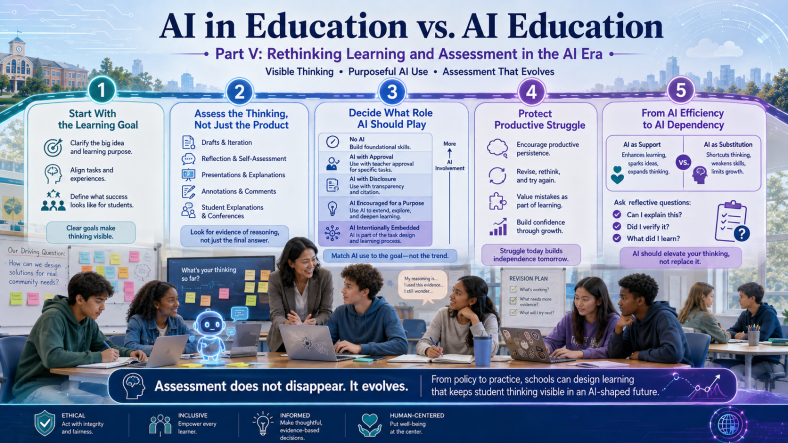
Start With the Learning Goal
Before deciding whether students should use AI, educators need to identify the instructional purpose of the learning experience.
- What should students know?
- What should they be able to do?
- What thinking should they demonstrate?
- What skills are we trying to develop?
Once those questions are clear, it is easier to decide what role, if any, AI should play in our instruction.
If the purpose of an assignment is to assess a student’s ability to organize and communicate their own ideas, then using AI to generate the response may interfere with the learning goal. If the purpose is to evaluate sources, revise weak arguments, compare perspectives, or improve a draft, AI may have an appropriate supporting role.
Instead of asking only, Can students use AI? I think a better question is:
What role should AI play in this particular learning experience?
Assess the Thinking, Not Just the Product
For many years, I was focused on the tools and final products to evidence learning. Whether it was an essay, a presentation, a project, or a worksheet. But now that we are in the AI era, we have to reconsider those final products. A final product does not always provide enough insight into what a student actually understands. We know that students may create great representations of their learning via final products, which they did without the use of AI, however, we may want more evidence of their learning along the way. Those products still matter, but in an AI era, we may need more evidence of the thinking behind them.
Some examples may be to ask students to provide:
- drafts
- annotations
- reflection questions
- process journals
- checkpoints
- revisions
- explanations of decisions
- demonstrations of how they reached their conclusions
These are not new strategies, but they are increasingly becoming more important, especially with AI. If the purpose of an assignment is student thinking, then the learning experience needs to make that thinking visible.
Decide What Role AI Should Play
One of the most important instructional decisions educators can make is determining the appropriate role of AI in an assignment.
In Part III, I shared an AI-use continuum that schools and educators can use as a starting point.
AI use may be:
- not permitted
- permitted with educator approval
- permitted with disclosure
- encouraged for a defined purpose
- intentionally embedded in the assignment
I believe that the same continuum becomes especially useful when we think about assessment.
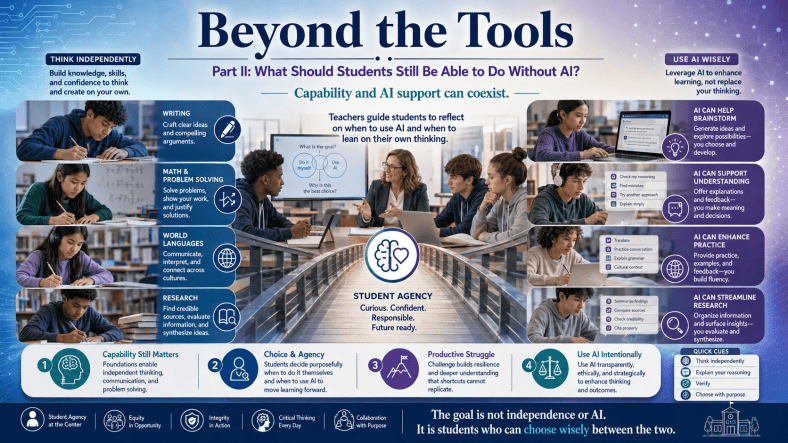
For example, AI might not be appropriate during an assessment designed to measure independent writing skills. We want students to develop student agency and be independent thinkers.
But AI could be intentionally included in an assignment that tasks students with critiquing an AI-generated response, identifying errors, comparing perspectives, or improving a weak argument. Even taking five minutes to have ChatGPT or any other LLM generate inaccuracies around a concept and then tasking students with critically evaluating it will make an impact on their learning.
Students might use AI to brainstorm ideas, but are still expected to create and defend the final product themselves. Being able to demonstrate learning, make thinking visible, and grasp the concepts and content they need to be successful, are essential.
Another idea is for students to partner with AI to receive feedback, rather than answers, and then explain which suggestions they accepted, which they rejected, and why. An activity like this really helps students to build those critical thinking and digital discernment skills. We always want to connect back to the learning goal and align with our instructional purpose.
Build in Evidence of Student Thinking
One of the best ways to preserve student ownership is to create opportunities for students to explain their thinking. It does not need to take a lot of time. It is possible through simple questions and activities. Some examples are to ask students:
- Why did you make this choice?
- How did you arrive at this conclusion?
- What evidence supports your answer?
- What did you change during the process?
- What did AI contribute? What did you contribute?
- What did you disagree with?
- What did you verify? How?
- Are you able to explain this without the use of AI?
These are just some of the guiding questions that can promote visible thinking and help students become more aware of their own learning process. Metacognition comes into play here.
For example, instead of asking students only to submit a final essay, educators might ask them to submit an outline, a short draft, be transparent about where they used AI, explain a revision they made, and briefly defend their final argument.
Here are some content area examples:
Science: Students might compare an AI-generated explanation with a verified source and break down and discuss where the response is incomplete or inaccurate.
Math: Students could analyze an AI-generated solution to a problem and explain whether the reasoning is correct.
Social Studies: Students could compare how AI explains the same historical issue from varying perspectives.
World Languages: Students might evaluate an AI translation and explain where meaning, tone, or cultural context changes and where there might be misunderstandings. I have done this with my own students.
In learning, the final product still matters, but so does the process that produced it.
Productive Struggle
AI can make many tasks faster, but faster does not always mean better for learning. An additional concern is that because AI can produce answers so quickly, students will not experience productive struggle. Students need opportunities to think through difficult problems, experience uncertainty, make mistakes, revise, and discover that their first idea is not always their best one.
If AI removes every challenge, it may also remove part of the learning.
I have explained to my own students about the importance of productive struggle. When they question me, I tell them that they need time to think through a difficult problem, to experience uncertainty, to make mistakes, to revise, and sometimes realize that the first idea is not always the best one.
If we rely on AI too much, it takes away the challenge and may also take away some of the opportunities for learning. And for this reason, completing things quickly and efficiently should not always be the goal in education. I’ve tried to convey that sometimes the process matters more than the speed. Sometimes finding the answer when working alone builds confidence. Sometimes struggling with a sentence or solving a math problem helps students develop the skills of resilience, collaboration, and student agency.
I consider this in my work and ask educators to consider which struggles are unnecessary barriers for students and which are essential parts of learning. We know that AI can help remove barriers, but pushing it further, it should not remove every challenge for students.
From AI Efficiency to AI Dependency
One of the biggest concerns I see developing is not simply whether students are using AI, but whether they are becoming overly reliant on it.
There is a difference. Think about the difference between using AI efficiently and relying on AI to do the thinking. Efficiency means selecting and using a tool or even a strategy to support a learning task while still maintaining ownership, judgment, and understanding. But on the other side, overreliance or dependency happens when students become unable or unwilling to complete the task without the tool.
Students need our guidance. In my work this past year with schools across the country, this is what I have heard from them. They want us to help them develop awareness and develop a checklist that they can work through to understand when they should and shouldn’t use AI. Some questions they can consider are:
- Could I do this without AI?
- Did AI help me think, or did it do the thinking for me?
- Am I able to explain this in my own words?
- Did I verify the information? How can I?
- What decisions did I make? (not the AI)
- What did I actually learn, and can I explain it to another person?
- Would I still understand this if the tool were unavailable?
Questions like this will help students build more than AI literacy skills. They will build self-awareness, which is important because we know that responsible AI use is not just about knowing how to use a tool, but it is also about knowing when to use it, how much to rely on it, and when to step away from it.
Assessment is Evolving
Concerns came right away. “The kids are going to cheat.” “It’s the end of assessments as we know them.” But AI does not mean we need to throw assessments aside. I believe that it means we have to be very clear about what we are assessing. Sometimes students ask simple questions. For example, as a Spanish teacher, can I give them the English word and have them match it with the Spanish word? But with AI, I have been thinking through this more. Here are my thoughts:
If we are assessing recall, there may be times when AI should not be available.
If we are assessing reasoning, students may need to explain their process.
If we are assessing creativity, students may need to show how their ideas developed.
For research skills, students may need to verify sources and defend why they trust them.
There are a lot of things to consider in our work as educators when it comes to AI. If AI is intentionally part of the learning experience, then evaluating how students use AI may itself have to become part of the assessment. I present these questions in sessions that I do and when talking with student focus groups. I ask them:
- Did you question the output?
- Do you recognize limitations?
- Can you identify bias?
- Are you able to verify claims?
- Can you make decisions about what to use and what to reject?
Students need to develop these skills because they are important, especially when considering their preparation for a successful future.
Where AI in Education and AI Education Meet
Throughout this series, I have focused on AI in Education and AI Education. Now, in this fifth and final part (I think), is where the distinction between them becomes especially important.
AI in education asks what role AI should play in the learning experience: whether students should use it, when, for what purpose, and under what expectations.
AI education asks whether students understand what AI is doing: whether they can evaluate its output, recognize limitations and bias, verify information, and make responsible decisions about its use.
Assessment brings both together because educators must evaluate not only what students produce, but also the thinking, judgment, and learning that led to it.
Students should not only demonstrate that they can use AI. They should demonstrate that they can think with it, think beyond it, and think without it when needed.
My Final Thoughts
Now that we have so many possibilities available because of AI, it does not make the learning process less important. It hopefully makes it more important and leads us to be more intentional in our instructional planning.
Educators have always been responsible for designing learning experiences that help students develop knowledge, skills, confidence, and independence, all of which will lead to future success.
AI challenges us to be more intentional and design learning experiences that make students’ thinking visible. We need to guide students to recognize the difference between using AI for enhancement versus replacement. And something that I’ve heard more frequently is not trading the efficiency that AI can promote for dependency on AI.
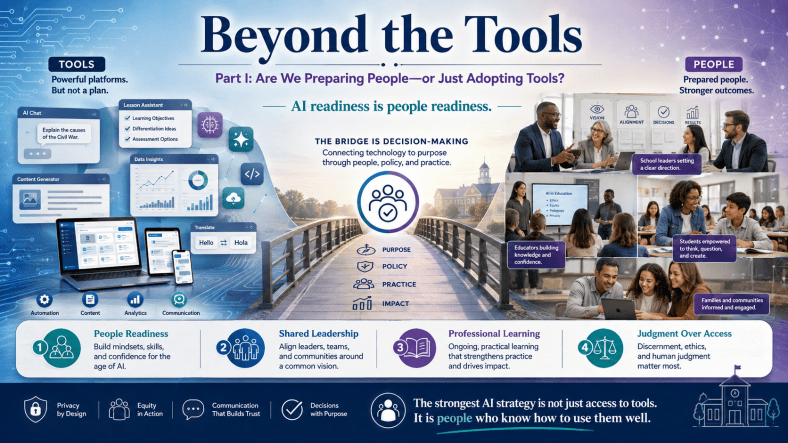
I think we are past whether or not AI belongs in education. It is here. Research and predictions for future work show that it will continue to be in demand. So as educators, we must prepare our students and ourselves to use it ethically and responsibly. We have to stay focused on how we can use it so it does not result in the loss of essential skills like critical thinking, productive struggle, reflection, creativity, and human judgment that make learning truly authentic and meaningful.
How we do this is an important question to consider as we continue moving forward in an AI-shaped world.
Thanks for reading this series and for the feedback.
Please subscribe to my ThriveinEDU newsletter to stay informed. And contact me for more information.
If Your Organization Is Beginning This Work
I help schools and other organizations (law firms, healthcare professionals, business owners) implement AI responsibly through policy guidance, professional learning, and classroom-ready strategies grounded in both instructional practice and legal insight.
My sessions focus on helping teams:
• understand what AI can and cannot do
• recognize responsible-use considerations
• build confidence using emerging tools
• align implementation with organizational priorities
If your school, district, or organization is beginning conversations or looking to dive in and learn more about AI policy, professional learning, or responsible implementation, I’d welcome the opportunity to support your next steps through leadership workshops, keynote sessions, or strategic planning partnerships.
Preparing people is what makes AI implementation successful. Contact me via bit.ly/thrivineduPD or email Rdene915@gmail.com, for my training and speaking services.